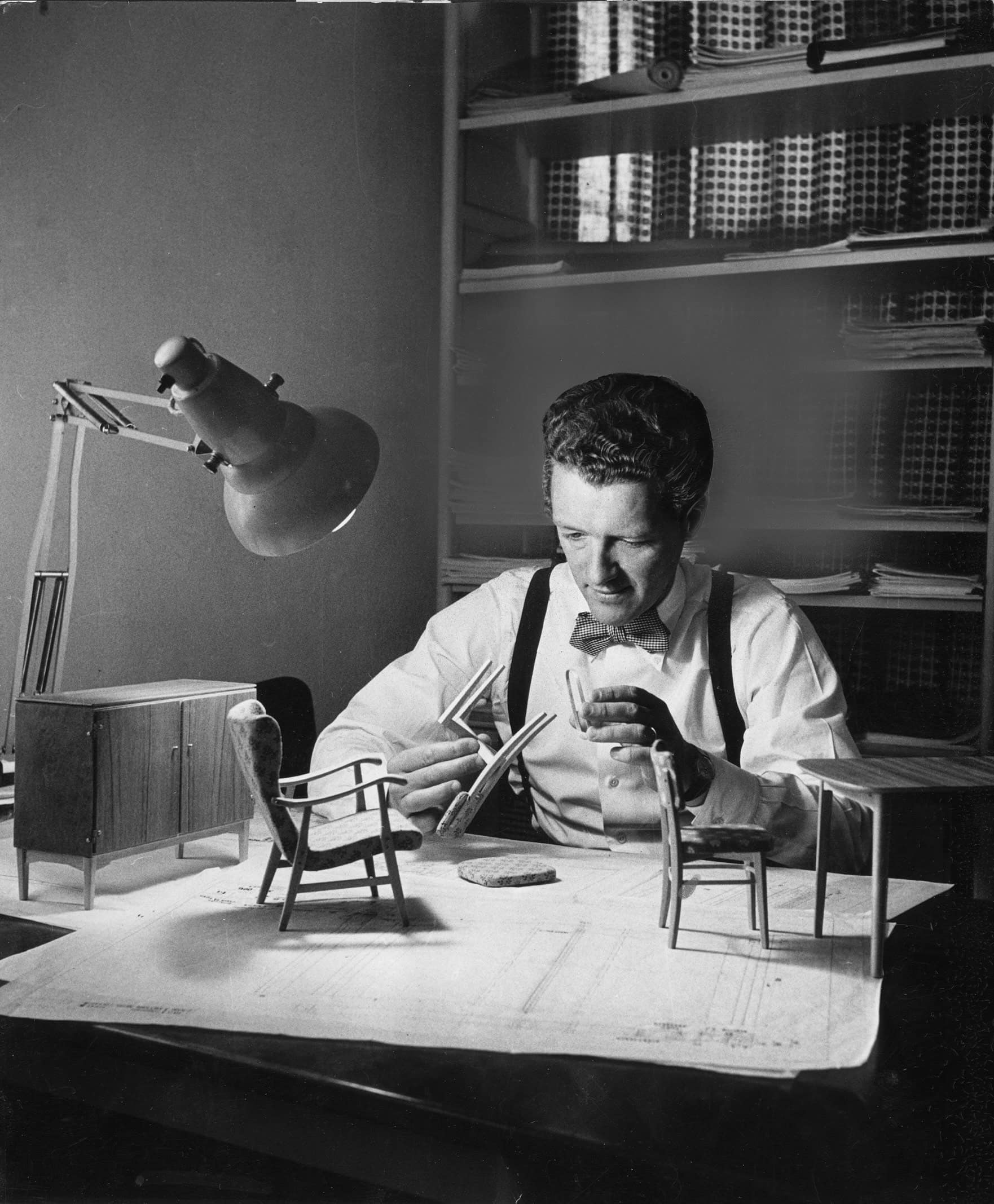
Elias Svedberg
Elias Svedberg (1913–1987) was a Swedish interior architect, furniture designer, and architect, closely associated with Nordiska Kompaniet and the development of modern Swedish home interiors during the mid-20th century. He is best known for his work with functional, accessible furniture and for his role in developing the Triva concept, where well-designed furniture was sold in flat packages and assembled by the customer. His work reflects a practical and democratic approach to design, where quality, comfort, and everyday use were central.
Biography
Johan Elias Svedberg was born in Uppsala in 1913. He was the son of The Svedberg and Andrea Andreen, and the brother of Hillevi Svedberg. After graduating in 1931, he studied with Carl Malmsten between 1931 and 1932, before continuing his education and work experience in the United States in 1933 and in Europe between 1934 and 1935.
Svedberg ran his own architectural practice from 1935 to 1944 before becoming consulting architect for Nordiska Kompaniet and its factory in Nyköping in 1944. At NK, he became one of the key figures in the company’s work with modern interiors and furniture. He was appointed head of NK’s interior design department in 1952 and later became sales director at NK in Stockholm.
During the Second World War, Svedberg developed the Triva furniture concept for Nordiska Kompaniet. The furniture was delivered in flat packages and designed to be assembled by the customer, combining practical production with accessible, high-quality design. The Triva Bygg furniture family was presented at the exhibition “Vi bo i Friluftsstaden” in Malmö in 1944, and the concept was later developed further together with Lena Larsson.
Svedberg also collaborated with Astrid Sampe at NK’s textile department and contributed to a broader understanding of the modern home as a complete environment. Together with Lena Larsson, he wrote the influential book Heminredning, which promoted practical, pleasant, and well-considered interiors for everyday life.
In addition to his work with furniture and interiors, Svedberg contributed to several exhibition and museum projects. He helped develop exhibition techniques for institutions such as the Coin Cabinet, the Museum of National Antiquities, the Nordic Museum, Stockholm City Museum, and the Museum of Far Eastern Antiquities, making these spaces lighter and more accessible to visitors.