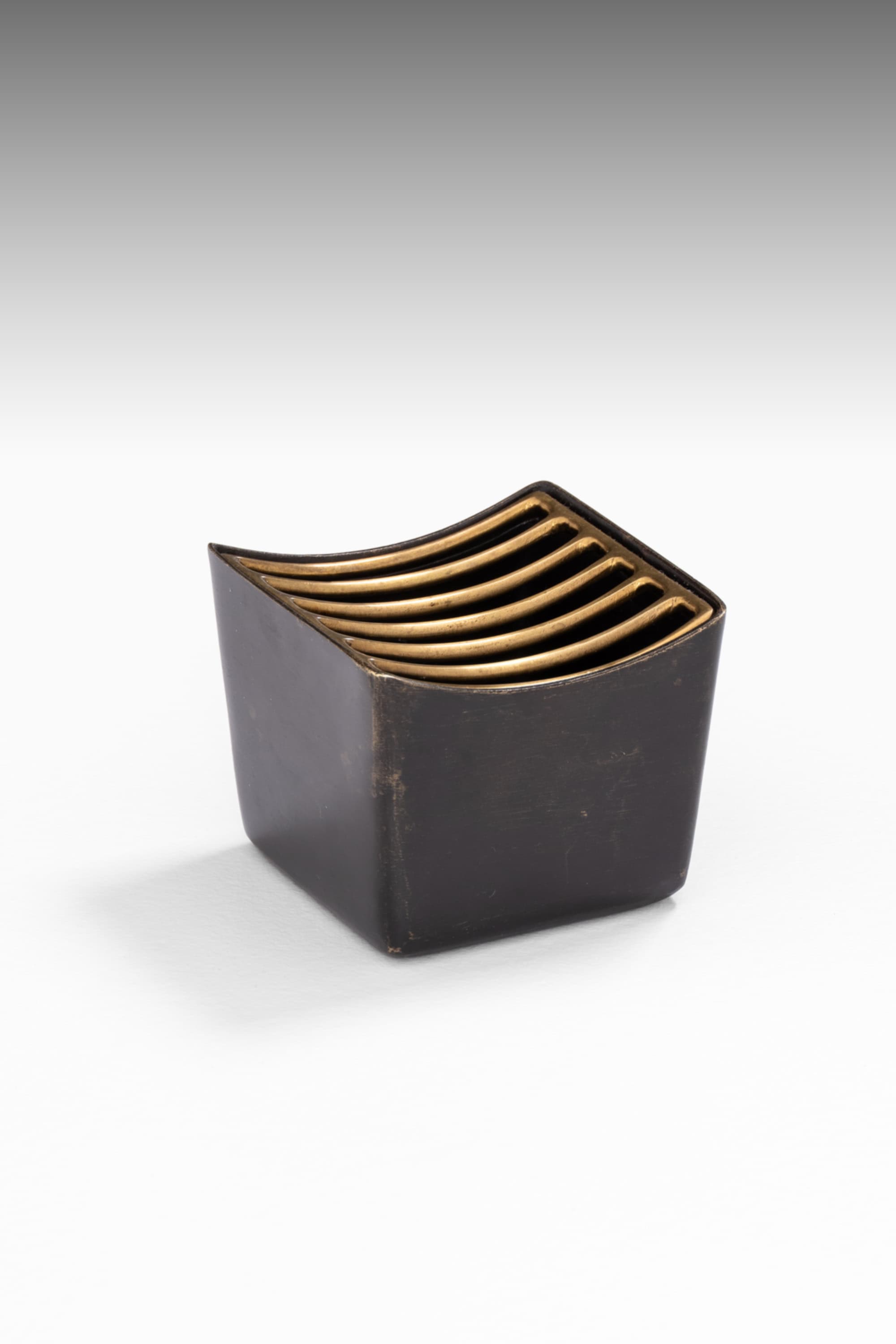
Karl Hagenauer
Karl Hagenauer (1898–1956) was an Austrian designer and artist, best known for his distinctive metalwork and decorative objects associated with the Art Deco movement. As the leading designer of Werkstätte Hagenauer Wien, he developed an extensive collection of handcrafted objects that combined functionality with expressive, stylized forms. His work, often executed in brass, bronze and wood, included animal figures, decorative sculptures and everyday accessories, reflecting influences from the Vienna Secession, African art and European modernism.
Biography
Born in Vienna in 1898, Karl Hagenauer was the son of Carl Hagenauer, a goldsmith who founded the family workshop in 1898. At the age of eleven, he enrolled at the Vienna School of Applied Arts, where he studied under Josef Hoffmann and Oskar Strnad. During his education, he also produced designs for the Wiener Werkstätte, gaining experience within one of the most influential artistic movements of early twentieth-century Vienna. Following military service during the First World War, he resumed his studies, qualified as an architect and joined the family business in 1919.
Hagenauer's early designs reflected the influence of the Vienna Secession, characterized by geometric ornamentation, carefully balanced proportions and an emphasis on craftsmanship. As his style developed during the 1920s and 1930s, he increasingly embraced the streamlined forms and decorative qualities of Art Deco. His work became particularly recognized for its stylized representations of animals, human figures and mythical creatures, often featuring elongated silhouettes, polished surfaces and playful expressions.
In addition to purely decorative sculptures, Hagenauer designed a wide variety of functional objects, including candlesticks, mirrors, ashtrays, cigar cutters, bookends and lamp bases. These pieces combined artistic imagination with practical use, frequently incorporating whimsical animal motifs and simplified geometric forms. His designs were presented at the International Exhibition of Modern Decorative and Industrial Arts in Paris in 1925, where he received both bronze and silver medals.
Following his father's death in 1928, Hagenauer assumed leadership of Werkstätte Hagenauer Wien. The workshop became internationally recognized for its finely crafted metalwork and decorative sculptures, with Karl serving as the principal designer of functional objects and his younger brother Franz specializing in sculpture. The company also expanded into furniture production, working with designer Julius Jirasek.
Hagenauer's work gained considerable popularity in the United States, particularly through the support of New York gallery owner Rena Rosenthal. Among his most celebrated creations were stylized figures inspired by the American entertainer Josephine Baker, reflecting the influence of contemporary performance, fashion and modernist art. His sculptures and decorative objects became highly sought after by an international clientele, contributing to the workshop's commercial success.