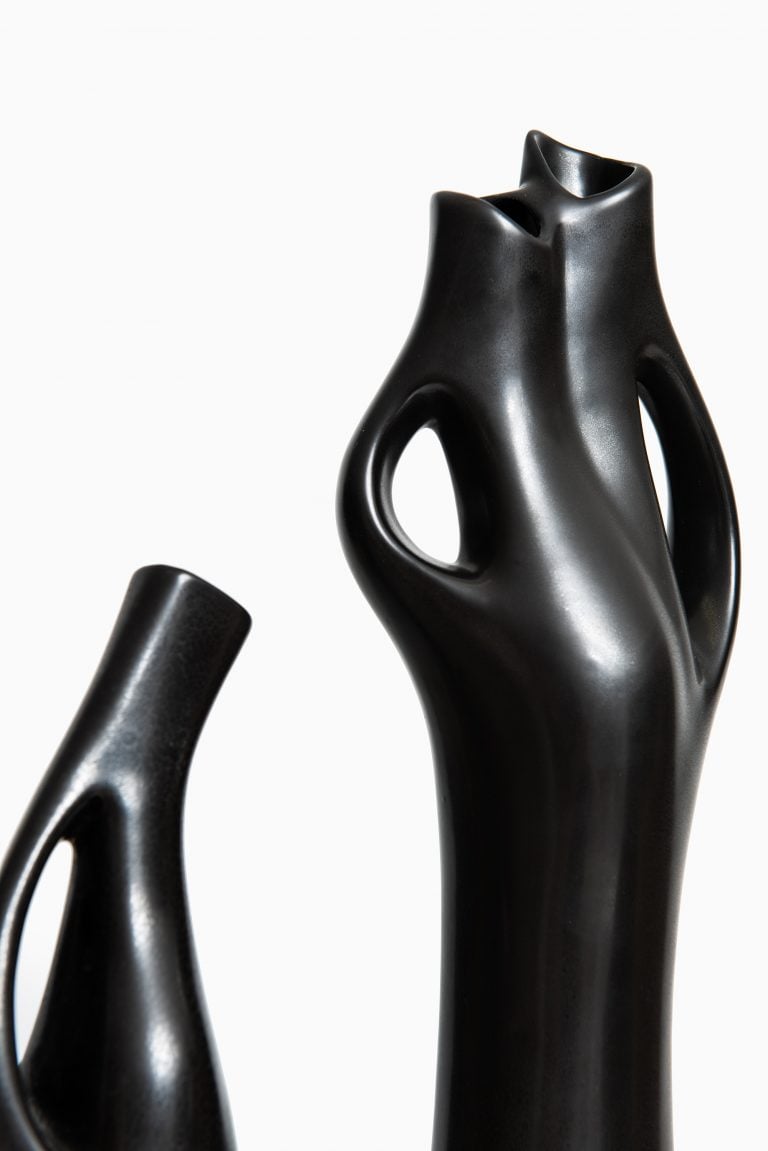
Lillemor Mannerheim
Lillemor Mannerheim (1927–1994) was a Finnish-Swedish ceramicist and designer, known for her organic vessels, animal sculptures, and refined work within mid-century ceramic design. She studied at Högre Konstindustriella skolan in Stockholm from 1945 to 1949, while also spending the summers of 1946 and 1947 as a trainee in the artistic department at Arabia Porcelain Factory in Helsinki.
Biography
After completing her studies, Mannerheim was employed as a designer at Gefle Porcelain Factory in Gävle, where she became one of several young women who contributed to the development of elegant post-war ceramic design in Sweden. At Gefle, she designed both tableware and decorative objects, including the tea services Kulisaner, Dixie, Labyrint, Mambo, Pärlor, Föl, Solros, and Singoalla.
In 1950, Mannerheim left Gefle to continue her studies in Paris at Académie de la Grande Chaumière, where she studied sculpture under Ossip Zadkine. During this period she also practiced at the Sèvres porcelain factory. She returned to Sweden in 1952 and resumed her work at Gefle Porcelain Factory.
Mannerheim is particularly associated with animal figures and ceramic sculptures, including antelopes, bears, cats, horses, turtles, and other animals. Her work often combined a sensitive sense of form with a playful but controlled expression, giving her figures a distinctive presence. She is also known for pieces in the Manganiaglaze, developed during the 1950s by engineer Arvid Nordbye.
In 1960, Mannerheim left Gefle and began working for Rörstrand, where she continued to design animal figures until 1964. She later worked for shorter periods with Guldkroken Keramik in Hjo and Hovmantorps Glasbruk, and also produced animal figures for Arabia Porcelain Factory.
Mannerheim participated in several exhibitions, including the Milan Triennale in 1954, Gävle Museum in 1955, and Presenta in Uppsala in 1956. Her work is represented by the sculpture Le Vieux Paysan in chamotte at Musée d’Art Moderne in Paris, and by the porcelain bowl Urhästen at the Röhsska Museum in Gothenburg.