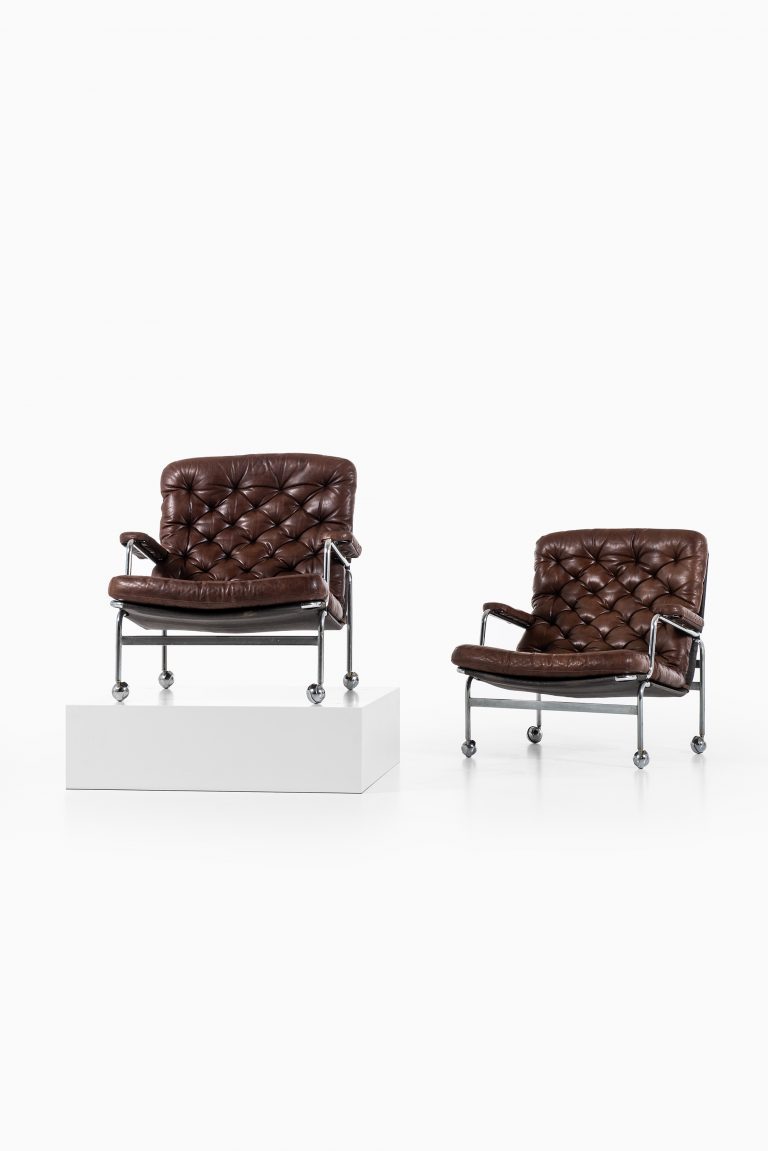
Bruno Mathsson easy chair
This early easy chair, model Eva, was designed by Bruno Mathsson and produced by Karl Mathsson in Värnamo, Sweden in 1941. The chair is constructed in laminated birch with the original hemp webbing, which has aged into a warm natural tone. The frame shows the characteristic organic curves associated with Mathsson’s designs, combining functional ergonomics with a sculptural elegance.
The Eva model was one of Mathsson’s earliest lounge chair designs and represents his philosophy of human-centered comfort. The seat and backrest follow the natural lines of the body, achieved through bentwood technology that allowed for a flexible and resilient structure. The woven hemp webbing provides both breathability and support, while also giving the chair a distinctive lightness in appearance.
Produced by Karl Mathsson, Bruno’s father, the chair reflects the close collaboration between designer and craftsman in the Mathsson workshop. The use of laminated birch and woven natural fibers situates the design within the Scandinavian functionalist tradition, with an emphasis on simple forms, innovative materials, and everyday usability. Over time, the Eva chair has become one of the most iconic mid-century Scandinavian designs.
This example remains in good vintage condition with visible signs of usage and patina consistent with age, contributing to its authenticity and historical character. The hemp webbing shows wear but retains its structural integrity, and the birch frame presents a warm surface with marks of handling and time.
Dimensions: width 49 cm (19.3 in), depth 63 cm (24.8 in), height 86 cm (33.9 in), seat height 38 cm (15.0 in)
Dimensions (cm) | W: 49 / D: 63 / H: 86 / Seat H: 38 |
| Producer | Firma Karl Mathsson |
| Decade | 1940s |
| Country | Sweden |
| Style | Mid Century, Scandinavian Modern |
| Material | Birch, Webbing |
| Designed in | 1941 |
| Item Number | 116946 |
Bruno Mathsson
Bruno Mathsson (1907–1988) was one of Sweden’s most influential modernist designers, internationally acclaimed for his functionalist furniture and contributions to postwar architectural design. His career was marked by a deep understanding of ...
Read more