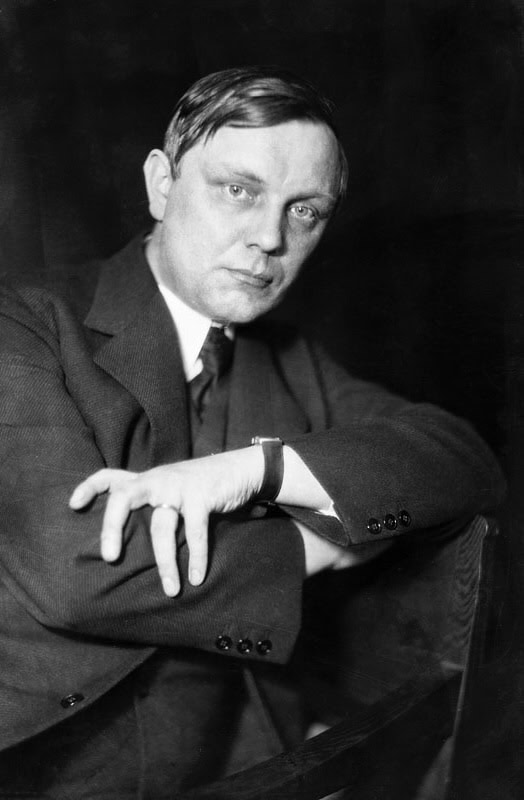
Gunnar Asplund
Gunnar Asplund (1885–1940) was a Swedish architect and designer and one of the most influential figures in 20th-century Scandinavian architecture. Educated at the Royal Institute of Technology in Stockholm, he developed an approach that moved from the refined classicism of his early work toward the emerging functionalism of the 1930s.
Biography
After completing his architectural studies, Asplund travelled extensively, including an important journey to Italy in 1914 that strengthened his interest in classical architecture, spatial composition and the relationship between buildings and their surroundings. His early works include Villa Snellman in Djursholm, completed in 1917–18, an important example of the transition toward what became known as Nordic Classicism.
Together with Sigurd Lewerentz, Asplund won the competition for Stockholm’s Woodland Cemetery, Skogskyrkogården, in 1915. The project occupied him for much of his career and includes several of his most significant works, among them the Woodland Chapel and, later, the Woodland Crematorium. The cemetery is today regarded as one of the major achievements of modern landscape and architectural design.
Asplund’s Stockholm Public Library, completed in 1928, became one of the defining works of Nordic Classicism. Only two years later, as chief architect of the Stockholm Exhibition of 1930, he adopted a markedly more functionalist language. The exhibition played an important role in introducing and establishing functionalism in Sweden.
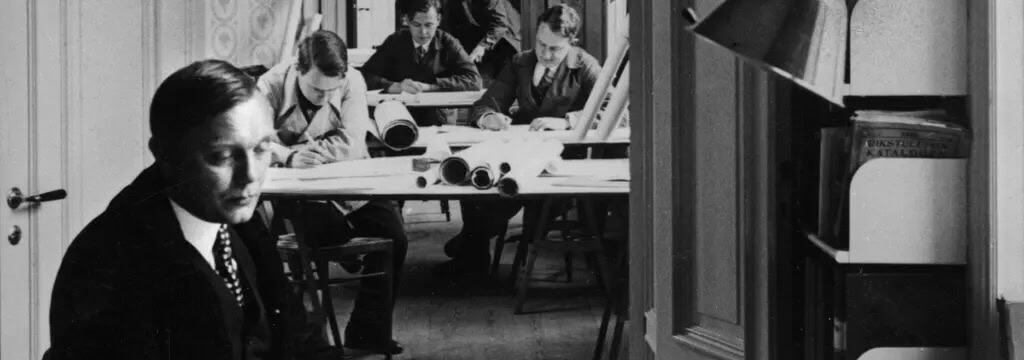
His later work included the extension of Gothenburg City Hall and the Woodland Crematorium at Skogskyrkogården. Alongside architecture, Asplund designed furniture, interiors and lighting, often treating these elements as integral parts of his buildings. He became professor of architecture at the Royal Institute of Technology in Stockholm in 1931 and remained an important influence on a younger generation of Swedish architects.
Asplund died in Stockholm in 1940 at the age of 55 and was buried at Skogskyrkogården. His work, spanning Nordic Classicism and modernism, had a lasting influence on Scandinavian architecture and on architects internationally.