


Poul Kjærholm chair
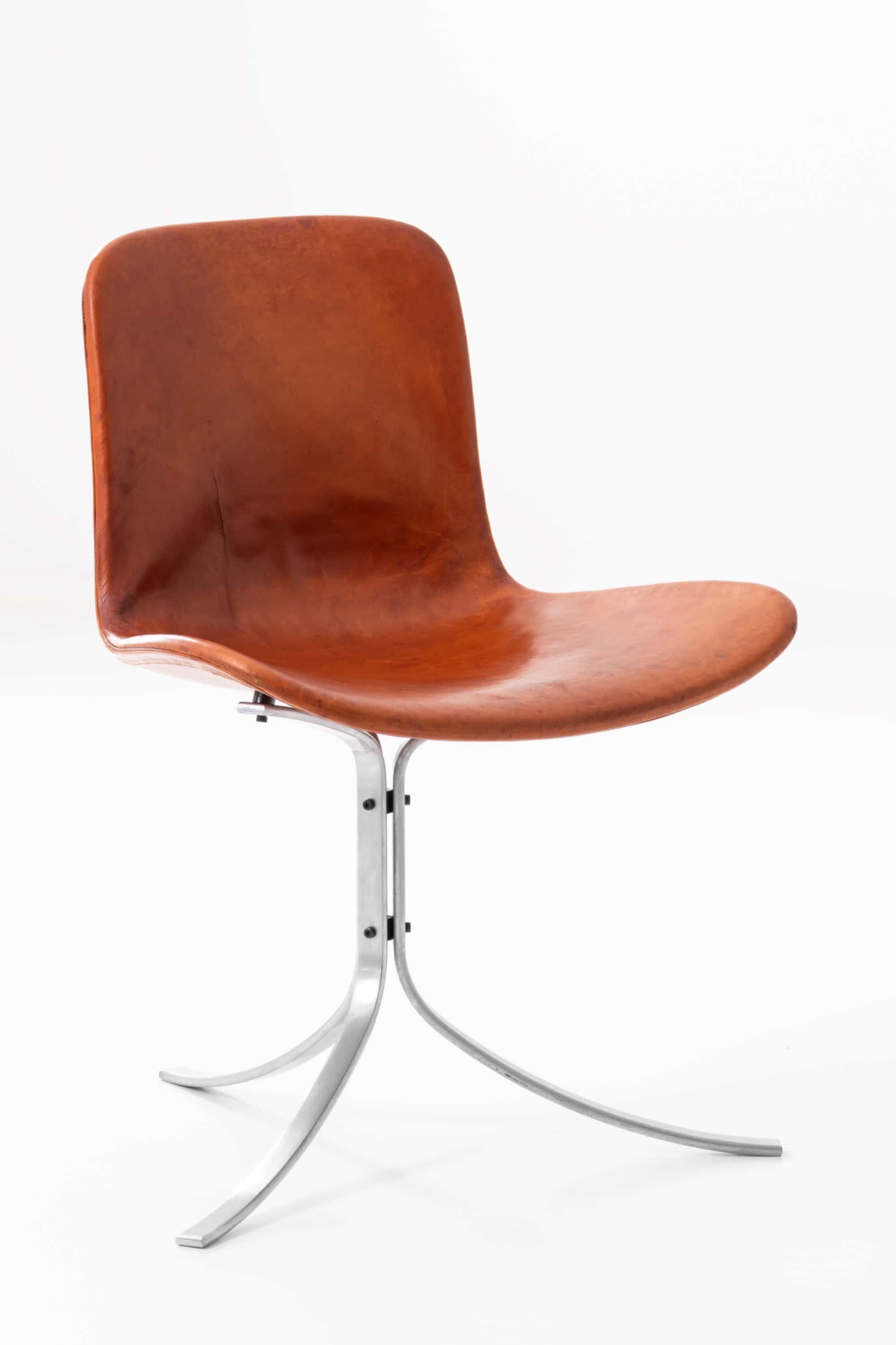
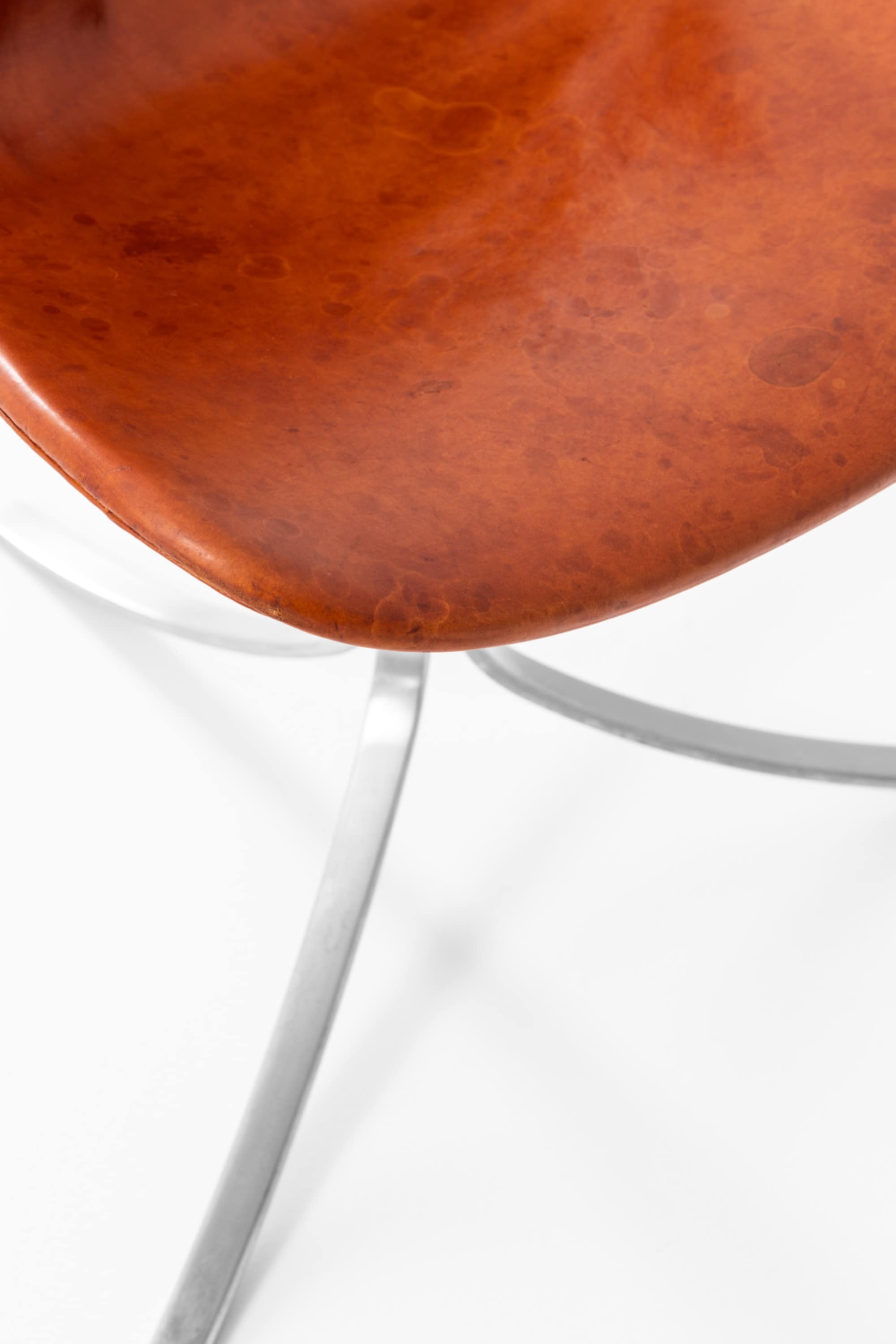
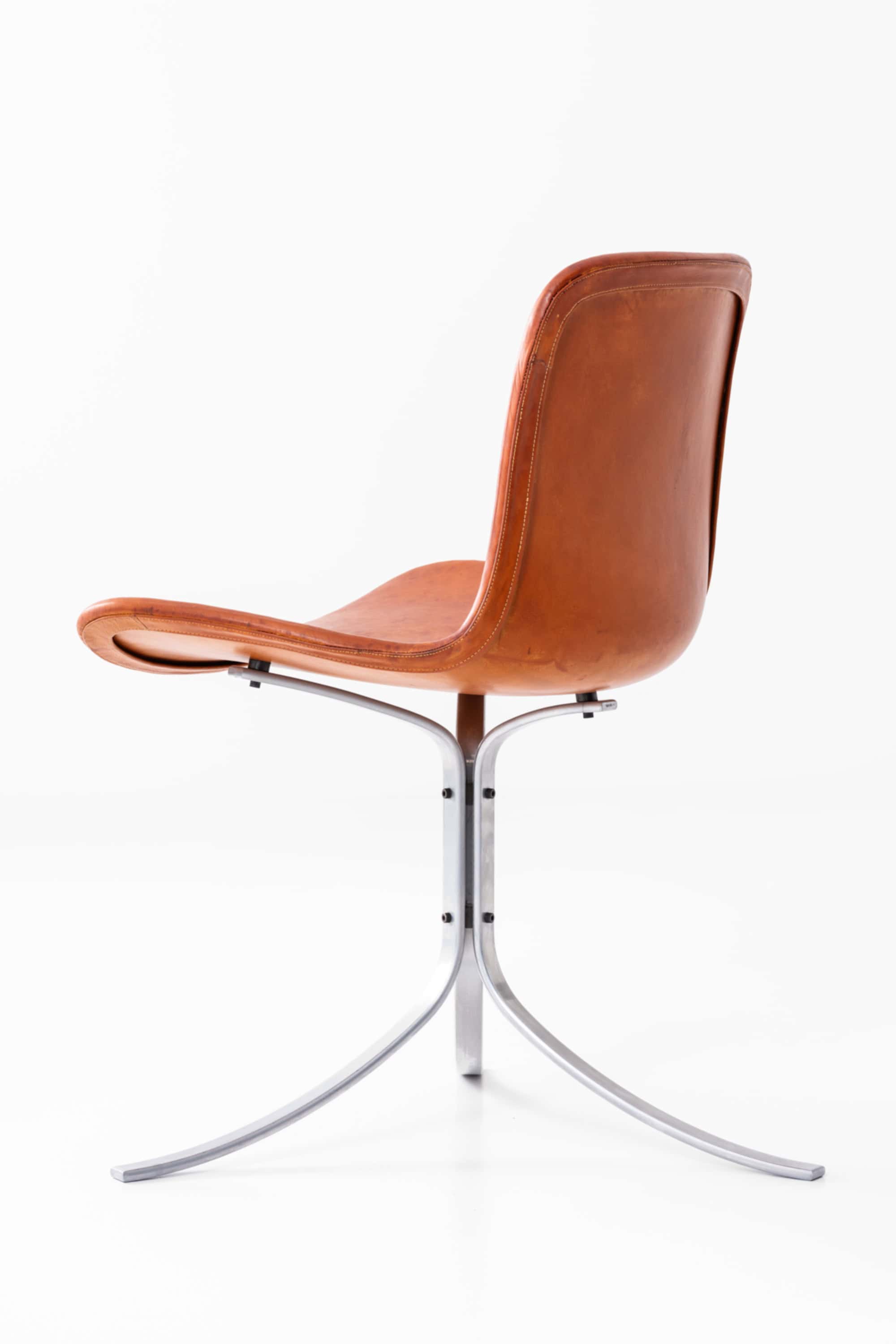
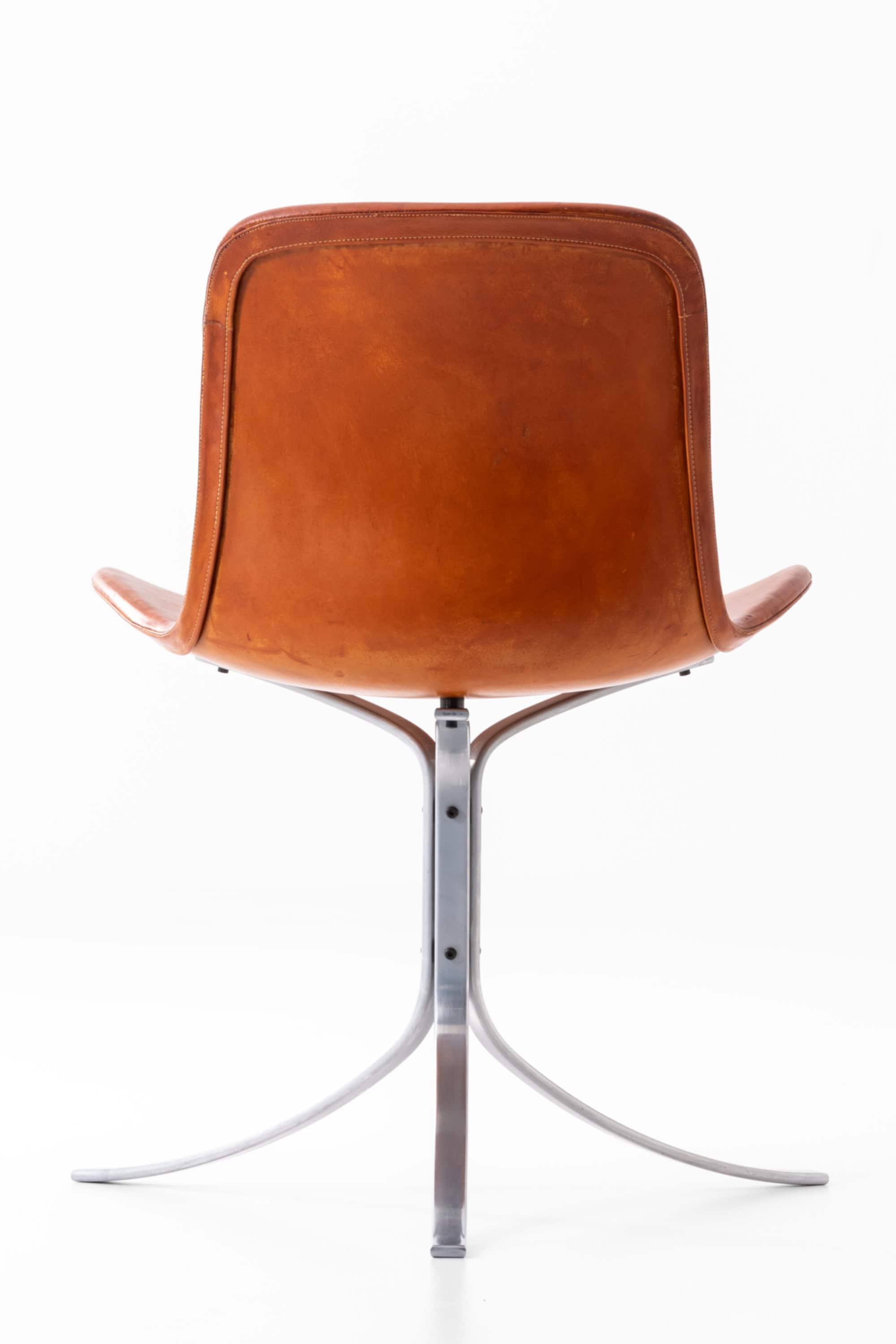
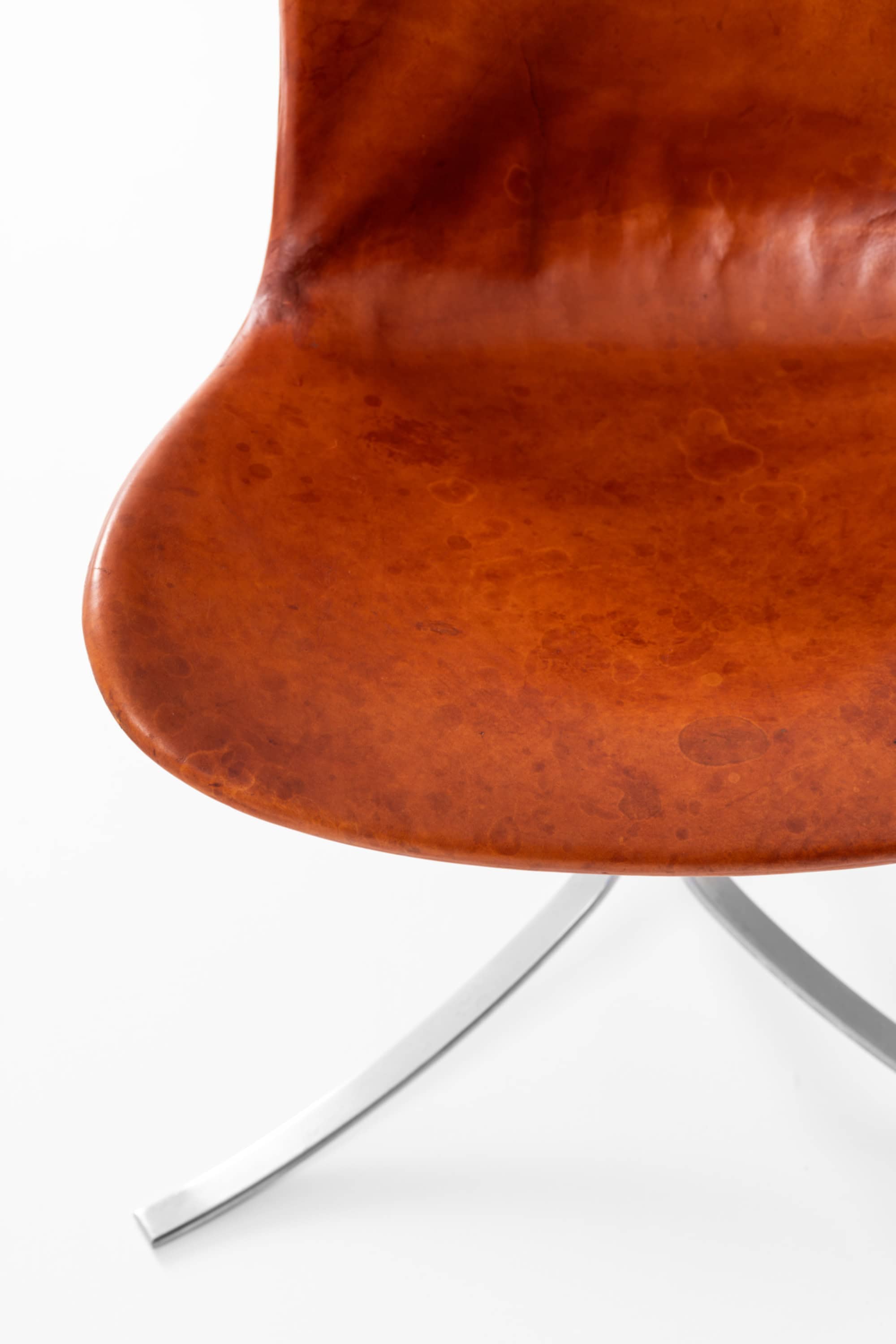
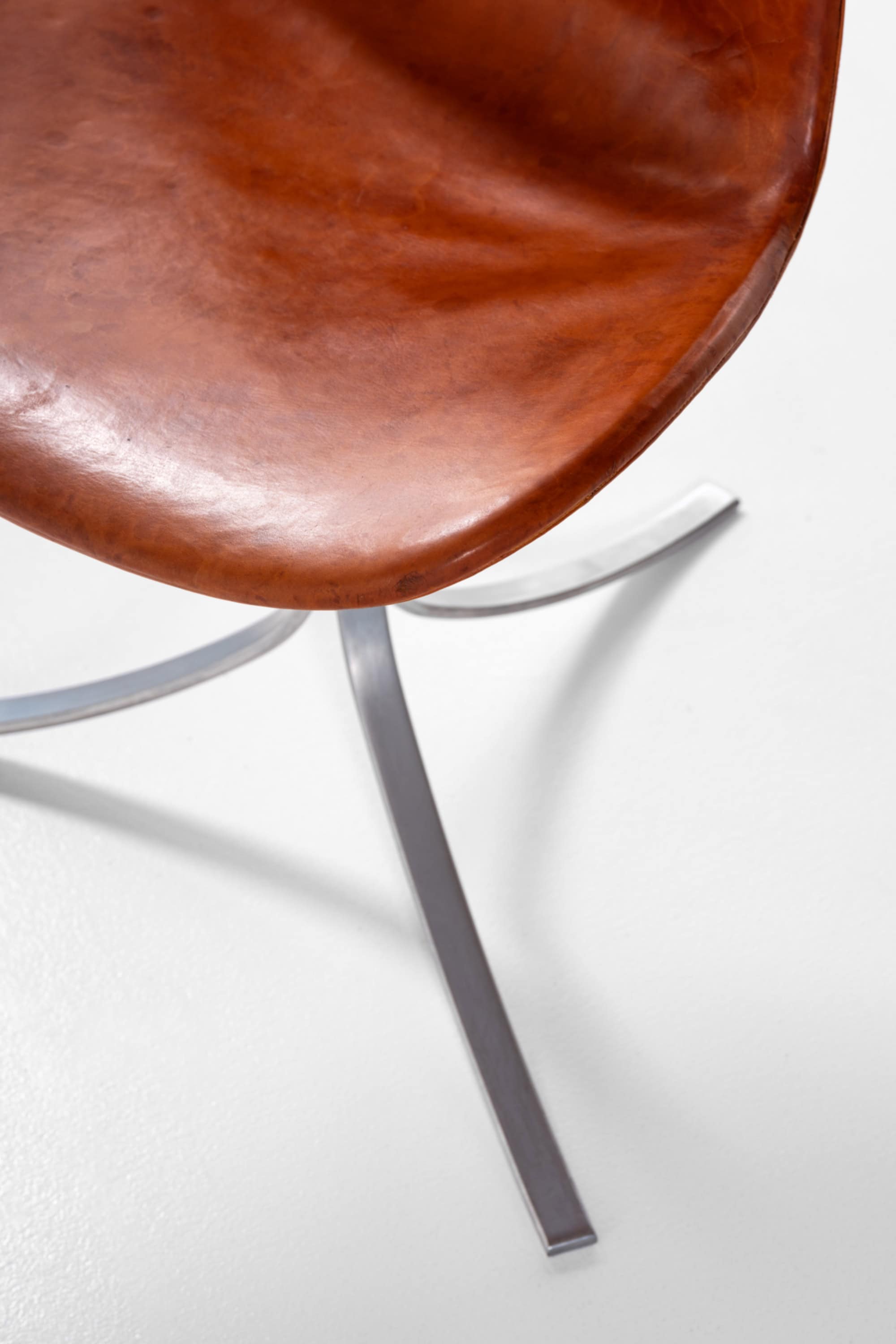
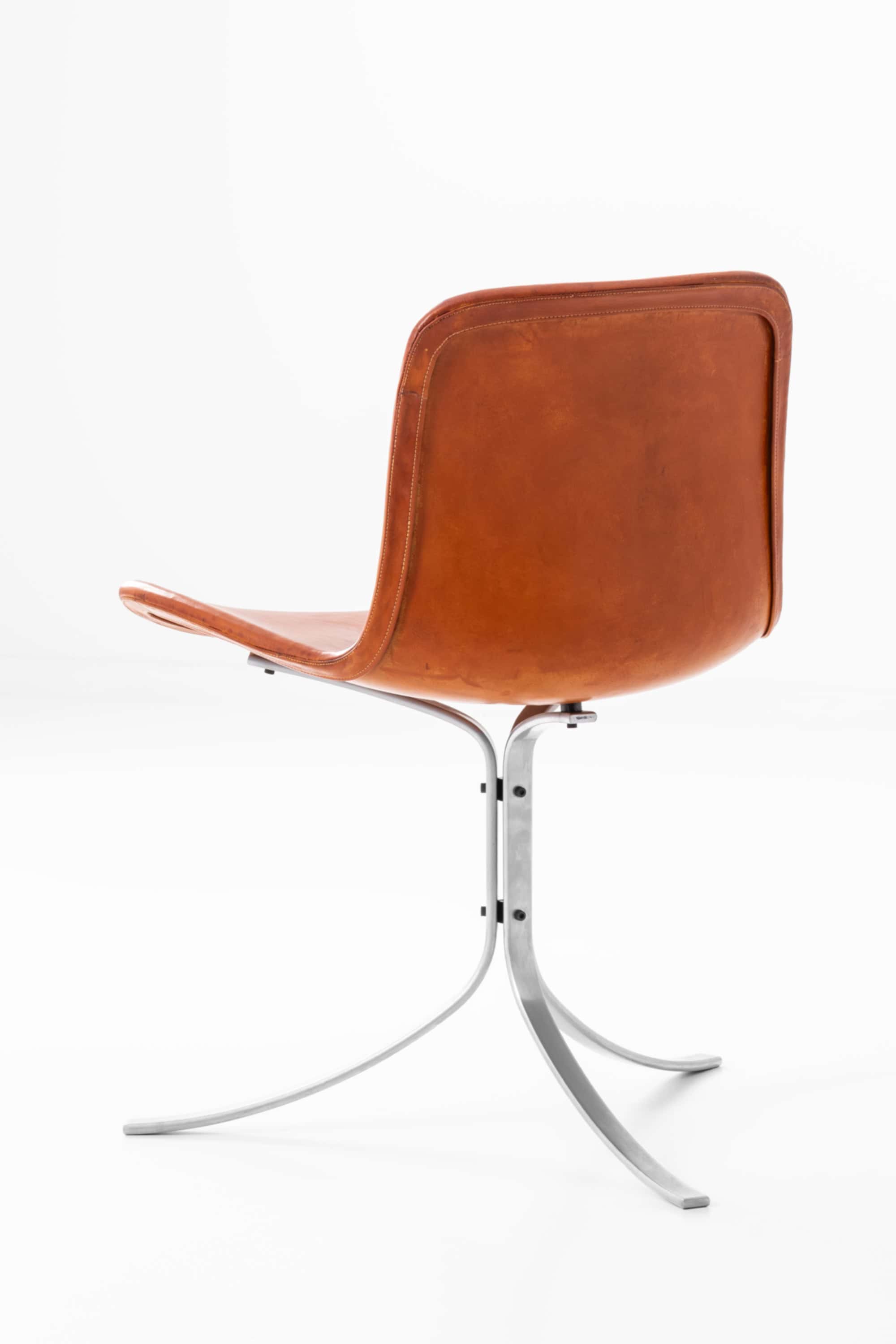
The chair features a continuous, organically curved seat shell that integrates the seat and backrest into a single flowing form. The backrest is relatively upright, with softly rounded upper corners and a subtle inward curvature that follows the contours of the body. The seat extends forward into a broad, gently raised front edge, while the transition between the seat and backrest forms a smooth, uninterrupted curve. The leather upholstery has a warm reddish-brown cognac tone, with natural variations in color and surface texture developed through age and use. The front surface is largely uninterrupted by visible seams, emphasizing the sculptural quality of the shell, while the reverse features carefully executed stitching following the perimeter of the backrest and seat.
The supporting structure consists of three curved steel legs arranged around a central vertical axis. Each leg is formed from a flat metal section that extends upward to support the seat before bending outward toward the floor. The legs create a stable tripod configuration while maintaining a visually lightweight appearance. Their elongated curves contrast with the rounded volume of the leather shell, establishing a clear relationship between the organic seating element and the precise geometry of the metal construction. Visible mechanical connections and fasteners beneath the seat express the chair’s construction rather than concealing its structural components. The satin-finished steel has a cool silver-gray appearance that contrasts with the warm leather upholstery.
Poul Kjærholm (1929–1980) was one of the most influential Danish furniture designers of the twentieth century. Originally trained as a cabinetmaker, he studied at the Danish School of Arts and Crafts in Copenhagen, graduating in 1952. Unlike many of his Danish contemporaries, who primarily worked with wood, Kjærholm developed a particular interest in steel as a structural material. He considered steel to possess qualities comparable to traditional natural materials and frequently combined it with leather, cane, marble, and wood. His work was strongly influenced by modernist architecture and furniture design, particularly the principles of structural clarity, functional construction, and material honesty. Throughout his career, he developed a distinctive design language characterized by precise proportions, minimal ornamentation, and an emphasis on the relationship between materials and form.
E. Kold Christensen was a Danish furniture manufacturer and an important collaborator in Kjærholm’s career. Their partnership began in the mid-1950s and continued throughout the designer’s lifetime. Christensen specialized in producing Kjærholm’s furniture with a high degree of technical precision, combining industrial metalworking with traditional upholstery and cabinetmaking techniques. The collaboration resulted in several of the most significant Danish furniture designs of the postwar period, including chairs, tables, benches, and lounge furniture. The PK9 belongs to this body of work and demonstrates the manufacturer’s ability to execute complex structural forms while maintaining the refined material quality central to Kjærholm’s designs.
The PK9 is sometimes referred to as the Tulip Chair because of its organic silhouette and the way its curved steel supports resemble the stems of a flower. Its development reflects Kjærholm’s interest in reducing furniture to a limited number of carefully resolved structural elements. The chair’s design also illustrates the broader development of Scandinavian modernism during the late 1950s and early 1960s, when designers increasingly explored industrial materials and new manufacturing techniques while retaining the emphasis on craftsmanship and functional simplicity. The combination of a continuous upholstered shell and an exposed steel support structure gives the PK9 a distinctive position within the history of Danish modern furniture.
The chair is preserved in good vintage condition, with visible signs of age and use. The cognac leather has developed a pronounced natural patina, including variations in color, darker areas, surface marks, and localized wear, particularly across the seat and lower backrest. Some drying cracks are visible in the leather of the backrest, together with natural creasing associated with the material’s age. The edges retain their rounded shape, and the stitching on the reverse remains visible. The steel base shows minor surface scratches and signs of use, while retaining its characteristic metallic finish. The overall condition reflects the chair’s age and the natural aging properties of leather and steel.
The chair measures 55.5 cm (21.9 inches) in width, 50 cm (19.7 inches) in depth, and 75.5 cm (29.7 inches) in overall height, with a seat height of 41.5 cm (16.3 inches). Its relatively compact proportions, integrated leather shell, and three-legged steel base illustrate Kjærholm’s approach to furniture as a synthesis of structural engineering, material craftsmanship, and sculptural form.
Dimensions (cm) | W: 55.5 / D: 50 / H: 75.5 / Seat H: 41.5 |
| Producer | E. Kold Christensen |
| Decade | 1960s |
| Country | Denmark |
| Style | Danish modern, Mid Century, Scandinavian Modern |
| Material | Leather, Steel |
| Designed in | 1960 |
| Item Number | 250861 |
Poul Kjærholm
Poul Kjærholm (1929–1980) was a Danish furniture designer celebrated for his refined minimalist aesthetic, deep respect for materials, and meticulous attention to craftsmanship. He is considered one of the leading figures of 20th-century Scandi...
Read more


